- Welcome to FSSS Nigeria!
- info@fsssolutions.org
- 1190, Mabushi, Abuja

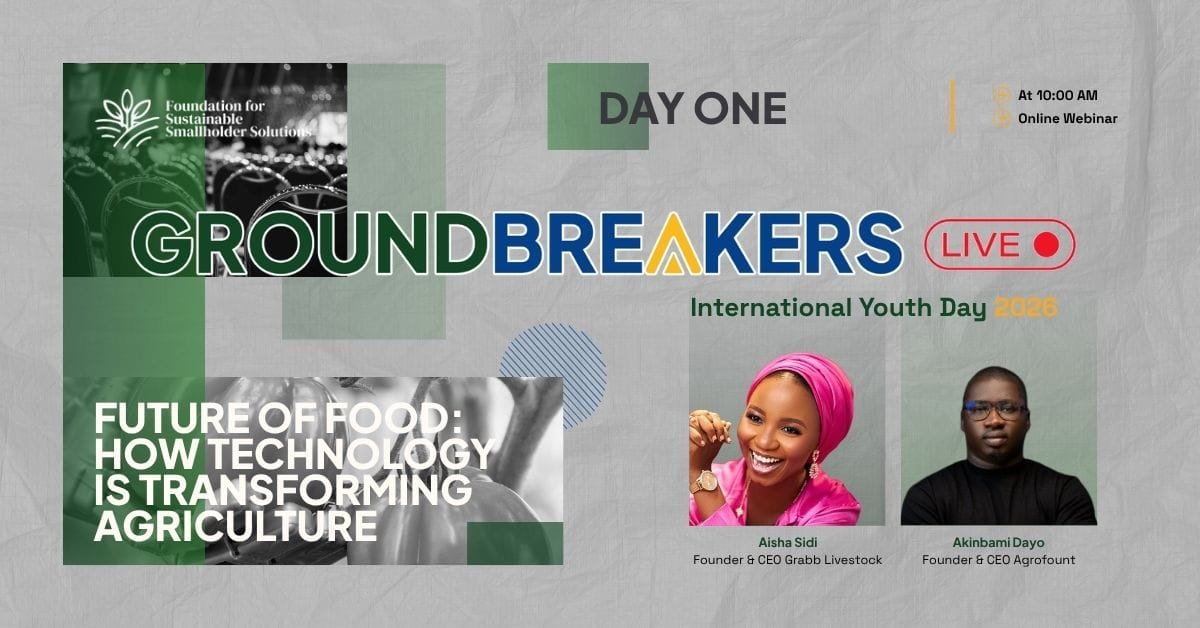
GroundBreakers Live 2026 Day One: Fall in Love with the Problem, Not the Idea – Aisha Sidi
AGRI INSIGHT
For many young people looking to build the next big agricultural technology solution, the starting point is often an idea. Aisha Rilwanu Sidi, CEO of Grabb Livestock, thinks that may be the wrong place to start.
“Don’t just fall in love with the idea, fall in love with the problem.”
It was one of the clearest messages from Day One of GroundBreakers Live 2026, during a conversation on Future of Food: How Technology is Transforming Agriculture. Speaking to young people exploring opportunities at the intersection of agriculture and technology, Aisha challenged them to look beyond the excitement of building something new and focus instead on understanding the problems they are trying to solve.
Her point was simple: a brilliant idea is not necessarily a solution.
The agriculture sector has no shortage of problems to solve, from limited access to finance and markets to inadequate information, post-harvest losses and rising production costs. At the same time, technologies such as artificial intelligence, digital platforms and data tools are opening new possibilities.
But technology alone is not the answer.
For Aisha, the starting point should be the problem. She advised young innovators to identify a problem that genuinely affects people, speak to 20 or 30 people experiencing it, understand how they are currently dealing with it, and then build the simplest possible solution.
Most importantly, they should test whether people are actually willing to pay for it.
“Someone saying that is a great idea is very different from someone saying, ‘Here is my money. Solve this problem for me.’”
That distinction can determine whether an idea remains an interesting concept or becomes a viable business.
Aisha’s experience with Grabb Livestock illustrates why understanding the user matters. When the company started, its platform was built as a web application. But the team soon discovered that many of the rural farmers they wanted to reach lacked the digital literacy required to use it.
The answer was not to ask the farmers to change. The technology had to change.
Following advice received, Grabb Livestock developed a USSD platform that could work on basic mobile phones. According to Aisha, the adjustment helped the platform grow from about 2,000 farmers to more than 50,000 farmers.
The experience reinforced her central argument:
“Build your tech, your architecture based on the farmers’ reality and there will be more adoption.”
It is a lesson that extends beyond livestock. In agricultural technology, the most sophisticated solution is not necessarily the most useful one. A solution that works on a basic phone may create more impact than one requiring a smartphone, constant internet access and a high level of digital literacy.
For Dayo Akinbami, CEO, CTO and Co-founder of Agrofount, understanding the problem also means understanding the information needed to solve it. During the conversation, he pointed to data as one area where young innovators can create practical value in agriculture.
Farmers, he explained, often struggle to access finance because lenders need reliable information to assess their businesses and the risks involved. Better farm records and data could help bridge that gap.
“Data is the first thing I want you to work on as a young woman… once you have that figured out, then you can apply it in any sector of agriculture that you are currently working in.”
His point was not simply that young people should work with data or artificial intelligence. Rather, they should first understand the problem well enough to know what information is needed and how technology can help address it.
That is already evident in Aisha’s work with Grabb Livestock. The company uses AI-assisted health and condition verification to help buyers assess animals remotely, while its digital platform connects farmers with buyers beyond their immediate communities.
“For us, tech is solving very practical problems: trust, market access, information…”
Whether it is making a platform accessible to farmers using basic phones, helping lenders better understand farmers through data, or building trust between livestock buyers and sellers, the principle remains the same: technology is most valuable when it responds to a real need.
That is why Aisha encouraged young Nigerians to look around their own communities for opportunities rather than assuming innovation must begin with a completely new idea.
Post-harvest losses, for example, continue to create opportunities for solutions around processing, drying and market access.
“Look within your locality, look within your community. What is the post-harvest loss happening? What area or what sector are we having problems with? And then try and provide a solution.”
She also encouraged young people to leave their rooms and engage directly with the people they hope to serve.
“Go into the field. Don’t sit in your room trying to imagine what farmers need.”
That means talking to farmers, visiting markets, speaking with processors and observing where value is being lost. It means asking questions before building products and testing assumptions before investing heavily in an idea.
Dayo offered a similar warning about trying to do too much at once.
“If you get yourself overwhelmed with too many ideas, you end up not solving any. So just pick one… and avoid distractions.”
For him, having an idea is only the beginning.
“Don’t just have an idea… make sure you have enough motivation to execute that idea.”
Aisha also encouraged young innovators to start small, test their ideas and accept that failure can be part of the process.
“Start small. Test the market, test your ideas and when you feel failure is allowed. When you make mistakes, mistakes are allowed. Learn from the mistake.”
In agriculture, where solutions must work in real communities and under real economic conditions, the willingness to test, learn and adapt can be just as important as the technology itself.
The future of agriculture will undoubtedly involve more technology. Artificial intelligence, digital platforms, data and other innovations will continue to reshape how farmers access information, finance, inputs and markets.
But the technology itself is not the destination.
The real opportunity lies in using it to make agriculture work better for the people who depend on it.
That is why Aisha’s advice to “fall in love with the problem, not the idea” is more than a message for aspiring tech entrepreneurs. It is a reminder of what meaningful innovation looks like.
It starts with listening. It starts with understanding. And, most importantly, it starts with the people whose problems you are trying to solve.
Dayo captured the broader message of the session:
“Nigeria doesn’t need technology for technology’s sake. We need young people who understand our problems deeply enough to use tech to solve them.”
The next big agritech solution may not begin with a groundbreaking idea.
It may begin with someone asking a farmer a very simple question:
“What is the biggest problem you are facing?”
Want to hear the full conversation?
Watch Day One of GroundBreakers Live 2026 and hear more from Aisha Rilwanu Sidi and Dayo Akinbami on how young people can use technology to solve real problems in agriculture.